
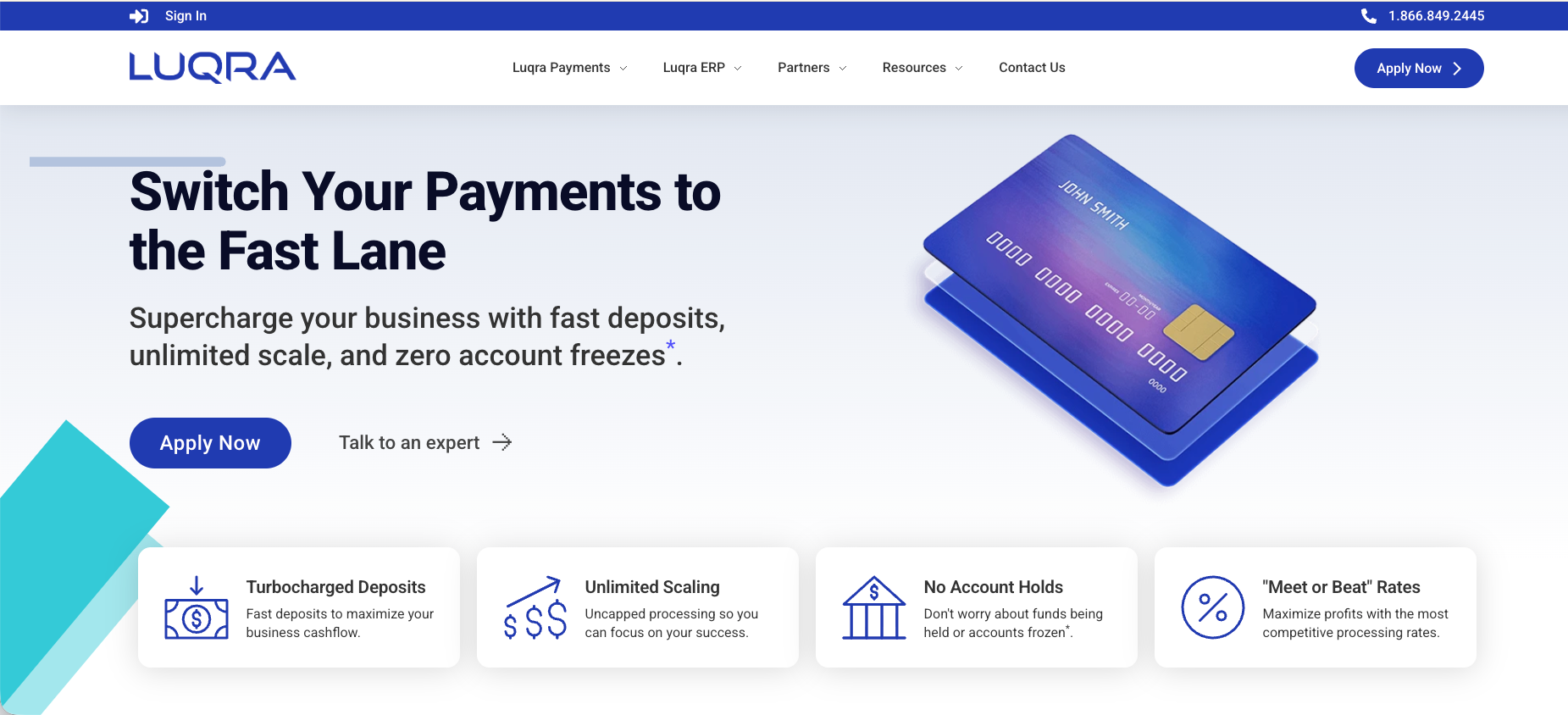
Luqra brand and payments context for the internal knowledge platform case study.
Overview
Luqra Knowledge Base is an AI-powered internal platform designed to centralize operational knowledge, training resources, SOPs, and support documentation for a growing payment processing organization.
The goal was to replace fragmented documentation spread across Google Docs, Slack conversations, spreadsheets, and individual agent notes with a secure, searchable, role-based knowledge platform.
I led the project end-to-end, including product strategy, UX design, system architecture, AI workflow integration, development, deployment, and ongoing optimization.
Project Snapshot
The platform served operations teams, support agents, sales agents, and administrators. The core focus areas were knowledge management, AI workflows, internal tooling, access control, and enterprise UX.
Internal Users
Operations, support, sales, content creators, and administrators.
Knowledge System
Structured articles, categories, partner data, SOPs, and training resources.
AI Workflows
AI-assisted feedback and QA triage to prioritize operational improvements.
Access Control
Role, department, and per-user visibility for sensitive payment operations content.
The Challenge
As the organization grew, critical operational knowledge became increasingly fragmented across Google Docs, Slack messages, spreadsheets, personal notes, and tribal knowledge.
This created challenges around information consistency, onboarding new employees, content governance, and secure access to sensitive information. The business needed a platform that could serve as a single source of truth while maintaining strict access controls and supporting rapid content updates.
My Role
I served as the sole product designer, architect, and builder of the platform.
- →Defined product requirements and roadmap
- →Designed user flows and information architecture
- →Created administrative and reader experiences
- →Implemented role-based access controls
- →Built AI-powered feedback and QA workflows
- →Led deployment and security reviews
- →Conducted ongoing usability improvements
Research & Insights
The project began by understanding how operations teams interacted with existing documentation. Research showed that agents needed answers in under 30 seconds, searchability mattered more than content volume, sensitive partner information required strict visibility controls, and documentation quality improved when users could provide feedback directly within the workflow.
These insights shaped the platform navigation, permissions model, and feedback system.
Fast Answers
Reader UX prioritized search, scanability, and direct routes to useful content.
Sensitive Access
Visibility rules protected partner and operational details.
Feedback Loop
Users could flag gaps directly from the knowledge workflow.
Governance
Admin tools made content easier to update, audit, and maintain.
Design Process
The design process focused on creating a platform that was easy to use for both content creators and support agents. Key activities included information architecture planning, content taxonomy design, workflow mapping, user testing with operations stakeholders, and iterative improvements based on live feedback.
The platform evolved through daily feedback loops, allowing rapid iteration and continuous optimization.
Solution
The final platform included role-based access controls, department-level content visibility, AI-assisted feedback triage, full-text search, favorites and content organization tools, audit logging and change tracking, mobile-responsive experiences, and integrated content management workflows.
A custom AI workflow automatically categorized incoming feedback, helping teams prioritize improvements more efficiently.
Role-Based Access
Reader, creator, and master-admin paths with secure visibility rules.
AI Triage
Approved QA feedback was classified and planned through Claude API workflows.
Searchable KB
Operational content became faster to find and easier to maintain.
Admin Tooling
Filament powered content, users, feedback, reporting, and audit workflows.
Impact
The platform transformed how operational knowledge was managed and maintained. It centralized knowledge across teams, improved content governance and security, reduced dependency on tribal knowledge, accelerated onboarding and support workflows, and enabled AI-assisted prioritization of operational feedback.
Most importantly, the platform enabled operations teams to manage and improve documentation independently without requiring engineering resources for routine updates.
Key Takeaway
This project demonstrated how thoughtful UX design, information architecture, and AI-assisted workflows can transform internal operations.
By combining product thinking, design systems, AI integration, and full-stack implementation, I was able to build a scalable platform that improved knowledge sharing, operational efficiency, and long-term maintainability.
What it proves.
Features and improvements delivered in roughly three weeks across reader, admin, content, feedback, and reporting workflows.
Centralized operational knowledge that had been spread across docs, Slack, spreadsheets, and individual notes.
Feedback and QA triage helped prioritize operational improvements without turning the system into an unsafe autonomous loop.